SHOEBAT EXCLUSIVE By Walid Shoebat and Theodore Shoebat
Iraq’s first Christian-only brigade of regular forces graduated Thursday to help retake the community’s towns and villages from the Islamic State group while they put the mark of God — the Holy Cross — on their foreheads, before marching to battle against ISIS. Christians are reviving a biblical custom from Ezekiel’s time in which God demanded to mark the foreheads of the followers of the true God (explained later).
Notice the Mark of God on the foreheads of Christians, the same as the Taw in Ezekiel’s time which was a foreshadow of the Cross.
Christian warriors have on their foreheads the Holy Cross — the Mark of God, while the Muslims have the Mark of the Beast
The new brigade will answer to the government of Iraq’s autonomous Kurdish region, whose peshmerga fighters are playing a leading role in the war against the jihadists. Fighters paraded and jumped through fiery rings in front of Kurdish and Assyrian officials in the northwestern town of Fishkhabur, near the borders with Syria and Turkey.
Assyrian Christian warriors
Assyrian Christian warriors
Assyrian Christian warriors
Most of Iraq’s Christians lived in the Nineveh plain, an area between the main IS hub of Mosul and the Kurdish capital of Arbil, before IS fighters swept in seven months ago. “Around 600 peshmerga from our Christian brothers in the Nineveh plain joined this course, which focused on physical training, military lectures and shooting exercises,” said Abu Bakr Ismail, the commander of the training academy.
“All the participants are volunteers… and want to liberate their land from IS and then protect it,” the Kurdish special forces major general said.
Iraqi Christian forces march during their graduation ceremony in the northwestern town of Fishkhabur
The new brigade is called the “Tiger Guards” and was formed out of the remnants of an Assyrian force first created in 2004 to protect churches in the region. Up to 100,000 Christians fled their homes overnight in early August when IS fighters who had already conquered large parts of Iraq thrust into areas controled by the peshmerga. The exodus has been described as the worst disaster to befall the minority, which is one of the world’s oldest Christian communities.
Iraq’s Christians have not traditionally had strong home-grown militias and adopted a low profile when sectarian violence flared across the country a decade ago.
But those who haven’t already fled the country have in recent months shown a willingness to take up arms and take their future into their own hands.
Several other Christian groups have formed in recent months in northern Iraq. They do not fall under the peshmerga’s command but are hosted and supported by Kurdistan.
There are also Americans joining the Christian militia, two of whom are Tim Locks and Bret, two courageous men Shoebat.com has written on before.
Tim 38 years old and was a bouncer for Cheekies nightclub in Staines, Surrey. Now instead of fighting troublemakers, he is fighting Islamic terrorists.
A great video of the US air force F-16 taking off with out its pilot. The General Dynamics (now Lockheed Martin) F-16 Fighting Falcon is a single-engine multirole fighter aircraft originally developed by General Dynamics for the United States Air Force (USAF). Designed as an air superiority day fighter, it evolved into a successful all-weather multirole aircraft. Over 4,500 aircraft have been built since production was approved in 1976.[3] Although no longer being purchased by the U.S. Air Force, improved versions are still being built for export customers. In 1993, General Dynamics sold its aircraft manufacturing business to the Lockheed Corporation,[4] which in turn became part of Lockheed Martin after a 1995 merger with Martin Marietta.[5]
The Fighting Falcon has key features including a frameless bubble canopy for better visibility, side-mounted control stick to ease control while maneuvering, a seat reclined 30 degrees to reduce the effect of g-forces on the pilot, and the first use of a relaxed static stability/fly-by-wire flight control system helps to make it a nimble aircraft. The F-16 has an internal M61 Vulcan cannon and 11 locations for mounting weapons and other mission equipment. The F-16's official name is "Fighting Falcon", but "Viper" is commonly used by its pilots, due to a perceived resemblance to a viper snake as well as the Battlestar Galactica Colonial Viper starfighter.[6][7]
In addition to active duty U.S. Air Force, Air Force Reserve Command, and Air National Guard units, the aircraft is also used by the USAF aerial demonstration team, the U.S. Air Force Thunderbirds, and as an adversary/aggressor aircraft by the United States Navy. The F-16 has also been procured to serve in the air forces of 25 other nations.[8]
Role Multirole fighter aircraft National origin United States Manufacturer General Dynamics Lockheed Martin Aeronautics First flight 20 January 1974 Introduction 17 August 1978 Status In service Primary users United States Air Force 25 other users (see operators page) Produced 1973–present Number built 4,540+[1] Unit cost F-16A/B: US$14.6 million (1998 dollars)[2] F-16C/D: US$18.8 million (1998 dollars)[2] Variants General Dynamics F-16 VISTA Developed into Vought Model 1600 General Dynamics F-16XL Mitsubishi F-2
Design Overview The F-16 is a single-engine, very maneuverable, supersonic, multi-role tactical fighter aircraft; it was designed to be a cost-effective combat "workhorse" that can perform various missions and maintain around-the-clock readiness. It is much smaller and lighter than predecessors, but uses advanced aerodynamics and avionics, including the first use of a relaxed static stability/fly-by-wire (RSS/FBW) flight control system, to achieve enhanced maneuver performance. Highly nimble, the F-16 was the first fighter aircraft purpose-built to pull 9-g maneuvers and can reach a maximum speed of over Mach 2. Innovations include a frameless bubble canopy for better visibility, side-mounted control stick, and reclined seat to reduce g-force effects on the pilot. It is armed with an internal M61 Vulcan cannon in the left wing root and has multiple locations for mounting various missiles, bombs and pods. It has a thrust-to-weight ratio greater than one, providing power to climb and accelerate vertically.[2]
The F-16 was designed to be relatively inexpensive to build and simpler to maintain than earlier-generation fighters. The airframe is built with about 80% aviation-grade aluminum alloys, 8% steel, 3% composites, and 1.5% titanium. The leading-edge flaps, stabilators, and ventral fins make use of bonded aluminum honeycomb structures and graphite epoxy laminate coatings. The number of lubrication points, fuel line connections, and replaceable modules is significantly lower than predecessors; 80% of access panels can be accessed without stands.[38] The air intake was placed so it was rearward of the nose but forward enough to minimize air flow losses and reduce drag.[58]
Although the LWF program called for a structural life of 4,000 flight hours, capable of achieving 7.33 g with 80% internal fuel; GD's engineers decided to design the F-16's airframe life for 8,000 hours and for 9-g maneuvers on full internal fuel. This proved advantageous when the aircraft's mission changed from solely air-to-air combat to multi-role operations. Changes in operational use and additional systems have increased weight, necessitating multiple structural strengthening programs.[59]
General configuration The F-16 has a cropped-delta planform incorporating wing-fuselage blending and forebody vortex-control strakes; a fixed-geometry, underslung air intake to the single turbofan jet engine; a conventional tri-plane empennage arrangement with all-moving horizontal "stabilator" tailplanes; a pair of ventral fins beneath the fuselage aft of the wing's trailing edge; and a tricycle landing gear configuration with the aft-retracting,
The Kabeirion, sanctuary dedicated to Kabeiros and Pais and situated about 6 km west of Thebes, had a long life (9th-4th c. AD) during which it underwent several changes. Initially dedications were clrearly made to Kabeiros and Pais, whereas in the classical period cultic features indicated a proximity to the cult of Dionysus. Probably, the rituals already included mysteries at that time. The archaeological and written sources of the Hellenistic and Roman period, however, more clearly point to the existence of secret mysteries. History
Perhaps the Kabeirion was founded at this spot due to the natural amphiteatrical formation. Then, in 1970 a test trench in the western area revealed a wall and a pebble pavement that date to the Bronze Age; but further excavations are needed to clarify its function and exact date. When cult activity started around 800 BC prehistoric remains might have been still standing upright marking the place as a very ancient site.
For about 300 years worshippers mainly dedicated bronze and lead figurines to Kabeiros and Pais as attested by several specimens inscribed with the name of either the one or the other. On the whole, the excavators unearthed more than 550 statuettes, mostly bulls which presumably represented a substitute for sacrificial animals or expressed the dedicators’ request directed to Kabeiros and Pais to guard their herds.
Scholars generally assume that no cultic buildings had been erected on the site before the 5th century BC, however some remains might belong to a preceding phase: the apsidal building , due to its typical Geometric ground plan and stratigraphical position; an angled wall below the Late Archaic Middle Tholos that belonged to a hearth; and the curved ‘polygonal-wall’ that had been incorporated in the Hellenistic temple . Almost all metal figurines were found densely packed at its inner side, placed there at the latest during the early Hellenistic period.
No built altar has been found yet, only a widespread layer of ash below the ‘Hellenistic fill’ that covered a large area east and north of the later temple . As most of the pre-Hellenistic votives came to light there, an ash altar very likely stood nearby.
Quite suddenly around 500 BC crucial changes occurred: worshippers were leaving more and more black glazed pottery in the Kabeirion, particularly kantharoi. In Boeotia this vase type was not only deemed Dionysus’ attribute, it had a chief significance as status symbol representing male virtues. Between 480 and 430 BC a prominent array of head vases came into use, in the shape of rams, mules, satyrs and maenads – all members of Dionysus’ entourage. In regard to the future development of the Kabeirion extraordinary vase types must have been an essential trait of the cult.
From the end of the 6th century BC on, worshippers also offered glass bead necklaces. Based on literary sources and vase images of women and children wearing a talisman necklace it can be assumed that the dedicators wanted their children to be protected by the gods or wanted a smooth birth guaranteed. From around 500 BC onwards votive figurines were chiefly made of clay but various new types emerged: standing boys, reclined men, squatted children, satyrs and several kinds of animals – about 3000 fully preserved figurines and fragments had been unearthed.
At the same time the Middle Tholos was erected and close by at least three other oval and round buildings that only partly survived. Next to the entrance of the Tholos a louterion for purification was found in situ. A circular bench ran along the interior wall and a hearth was placed in the center, which indicates that the Middle Tholos probably accommodated banqueters.
Two ‘sacrificial’ pits were found in the western part of the precinct, filled with black glazed pottery of the early 5th century BC. There is no firm evidence for a continuous use but it is striking that the later Roman ‘bothros’ altar was placed exactly above them.
Also during the 5th century BC two stone semi-circles were laid out in the western part of the Kabeirion (. In its center a libation altar, a large tapered pot, was lowered into the ground that was inscribed with the name of Thamakos (ΤΟ ΘΑΜΑΚΟ). Around 400 BC a ring of stone blocks was raised above it. The round shape of these buildings derived from enclosed burial mounds. Thus, the Lower Tholos seems to have been a shrine of an otherwise unknown hero, named Thamakos.
Around 430 BC a rectangular banquet house was built and sometime during the 4th century BC, another one was set in the southern hillside . Other indefinite remains of classical buildings were discovered all over the central area. Cultic life changed yet again around 430 BC. While the head vases slowly disappeared, an exceptional local ware was introduced: the Kabeiric vases. They were exclusive-y made for the sanctuary until Alexander the Great destroyed Thebes in 335 BC and the entire cult came to a sudden halt.
The black-figured Kabeiric vases depict deformed figures in a wide range of comical or grotesque scenes. Similar to some of the dancing scenes several images refer to the cult festival in the Kabeirion. They show men reclining on the ground as it is also known from festivals for Demeter and Dionysus. Other images depict white bearded men, perhaps priests, and some show worshippers – families and couples – approaching the reclined Kabeiros or a bearded herm. Kabeiros resembles Dionysus, Pais appears as his cup bearer. For understanding the Classical cult of the Kabeirion it is significant to note that the worshippers appeared with an ugly body on the vases – making them comical and thus transforming them into “others” and a thiasos of the Kabeiric gods.
The majority of Kabeiric vases preserved were small and decorated with ivy sprays and garlands between the handles. Presumably, they imitate wreaths laid around the vases, as known from the Athenian Anthesteria for Dionysus.
From 400 BC onwards mainly terracotta figurines of young men were dedicated in the Kabeirion, but black-glazed pottery was still in use. During the Classical period a noticeable amount of Panathenaic prize amphorae was offered possibly by the athletes themselves who can be associated with the wealthy Boeotian middle class, like the Thespian hoplites who fell at the Battle of Delion in 424 BC and were bestowed with Kabeiric vases in their mass grave.
Around 450 BC small bells and spintops made of clay (about 7 cm high) and bronze (about 1 cm high) were offered to Kabeiros and Pais. Both items were often found in children’s graves.
Since the Archaic period dedications were inscribed with votive inscriptions, one of them calling Pais Kabeiros’ son. At least a quarter of the dedicators’ names are female – so both, men and women worshipped Kabeiros and Pais, as also shown on some Kabeiric vases.
Apparently, the classical Kabeirion housed a Dionysiac cult within a rude comical setting. Thinking of Pausanias who mentions the Roman cult to be a secret mystery cult the Classical festival could have included ecstatic revels and banquettes on the ground. But indeed neither all bacchic groups performed secret rites nor do we now about a sanctuary for such rituals. The cultic ecstasy brought a short-termed relief from everyday life. On the other hand, the strong presence of boys and families in the Kabeirion indicates that Kabeiros and Pais, father and son, were probably venerated to watch over the young ones. But there is no evidence – as some scholars stated – and there are no parallels known for secret rites of passage from childhood to manhood.
At the beginning of the 3rd century BC, perhaps along with the refoundation of Thebes in 315 BC, the classical Kabeirion was buried under a vast earth fill – retained by an oval wall – and the sanctuary was completely rebuilt. Early construction works included the installation of a water supply system and a canal that was later connected to the Eastern Reservoir. A short time later, this double cistern was put out of service and perhaps replaced by the Western Reservoir.
Over the course of the 3rd century BC the first doric temple was erected; and between 150 and 100 BC, a pronaos and an annex room with two side doors were added. In the annex the excavators unearthed two sacrificial pits lined with stone slabs (nowadays lost). The southern one held thighbones of sheep and goats, the northern one contained earth that perhaps derived from deposited meat. There is also no open-air altar preserved.
At the temple’s southeast corner a colonnade closed up the forecourt and lined the way to a stairway. During the same construction process a flat podium was laid out in the orchestra but no traces of ash or bones were found pointing to a sacrificial use. Still during the 3rd century BC two stone-semicircles were laid out above the theatre enclosing three pits . When the sanctuary was re-structured large nests of Kabeiric vases were “buried” alongside them. Based on some curved stone blocks that were found nearby the excavators re-constructed an Upper Tholos on top of the semicircles. However, two east-west-aligned walls would interrupt the alleged round foundation; and after all, this area hasn’t been fully excavated yet.
The entrance of the sanctuary was now closed up by an array of rooms, unfortunately, many of them had been cleared away in the meantime. From there the temple court could be approached via a stairway no longer extant. The southern stairway led uphill: this path was lined by the Western Stoa and ended in a court closed up by another stoa to the south. At this spot the orchestra – about 7 m below – was well visible; perhaps, the area served as a theatre.
During the second half of the 3rd century BC earth was banked up and retained by long walls in order to extend the natural theater. In the 1st century BC the theater was re-built in stone and parts of an unknown Doric temple were transferred into the Kabeirion. Finally the sanctuary was enclosed by a wall. In the east a passageway led from the Southern Stoa towards the Roman theater.
Since the beginning of the Hellenistic period the dedication of terracotta figurines ceased. Now Homeric and Megarian bowls and unguentaria came into use. This large amount of unguentaria, however, dedicated to the Kabeirion may indicate that the cult had developed a strong chthonic character in the Hellenistic period, since this pottery type was found all around the Mediterraneanoften in graves. In Roman times also glass balsamaria were dedicated, and worshippers left a considerable amount of drinking vessels made of very delicate glass.
Several inscriptions on stone are preserved, the earliest dating back to the beginning of the 3rd century BC. This one lists the cult personnel for the mysteries: four “Kabeiriarchai”, later reduced to three and then two, and twelve “Paragogoeies” who probably introduced the adepts into the cult. In the 2nd century BC members of renowned Theban families held the priestly offices. A late 3rd century inventory of very valuable votives emphasizes the sanctuary’s prosperity at that time. The cult finally ceased in the 4th century AD.
Still in the Roman period Kabeiros and Pais appeared separately in inscriptions; only Pausanias used the plural name Kabeiroi (9.25.5). He describes a complex foundation myth of the Kabeiric mysteries: Prometheus and his son Aitnaios of the Kabeiroi-people founded the cult after they had received the secret mysteries from Meter. The goddess and her daughter Kore were venerated nearby (their sanctuary has not been detected yet). Later the Argives drove out the Kabeiroi but Pelarge, daughter of Potnieus, established the mysteries again, at a place called Alexiarus. Then Telondes of the Kabeiroi according to an oracle from Dodona established a cult for Pelarge and returned to the former site of the Kabeirion. Pelarge’s father was the eponymous hero of the Boiotian town Potniai. It seems that at the time of Pausanias a mythical explanation of the mysteries had been construed, but so far none of the mentioned gods and heroes is known from the archaeological record.
Description
The sanctuary of the Kabeiroi is situated 8 km west of Thebes. It was devoted to 2 deities, Kabeiros and Pais, both of unknown origin, to which Demeter revealed mysteries aiming at reinforcing the fertility of nature animals and human beings. The Kabeiroi were worshiped as protectors of wineyards and animal fertility; associated are 1400 representations of bulls found at the site. The cult in the sanctuary began in the archaic period (700-500 B.C.) and continued unil late antiquity (4th c. A.D.). The pots on the sanctuary bear typical decoration with grotesque carucaturated figures. Some neolithic (6000-3000 B.C.) sherds from beneath the temple attest an earlier occupation of the site, before its use as a religious center. In 1887 small bull figurines had turned up on the Athenian art market that were inscribed and dedicated to Kabeiros. Soon afterwards the Theban antiquity service discovered the Kabeirion. Until then the sanctuary of the “Kabeiroi” was only known from the 2nd century AD travel writer Pausanias (9.25.5-10), who revealed its location close to a grove of Demeter and Kore and gave an account of the Roman foundation myth (section 3.3) yet remaining silent about the cult. Still in 1887 and 1888 the German Archaeological Institute at Athens excavated the central area of the sanctuary – the temple and its adjacent structures. Work resumed 70 years later, in 1959. By then numerous stone blocks had been removed, entire buildings had vanished. The excavations proceeded until 1970 but have never been completed; parts of the sanctuary and its ancient boundaries are still unknown.
Statuette of a bull
Archaic, late 6th century b.c. Greek, Boeotian; from the Kabeirion at Thebes Bronze; H. 1 13/16 in. (4.6 cm), W. 2 13/16 in. (7.1 cm) Inscribed in Greek: Thaletas dedicated me to the Kabeiroi Rogers Fund, 1920 (20.210)
The first FIRESENSE pilot site located in Kabeirion, Boeotia, Greece. Two other archaeological sites of ancient Boeotia were initially also considered as candidates. The site was chosen because it is frequently threatened by wildfire: Kabeirion was burnt in the summer 2007 and this caused flooding during the winter.
Site Monuments
The most important monuments of Kabireion are: The Temple : devoted to the gods called Kabeiroi. It is a rectangular building the oldest remains of which are dated at the 6th c. B.C. onwards. The preserved foundations are from the end of the 4th c. B.C., but later renovations involving annexe on W. of the temple were in the 2nd and 1st c. B.C. The temple was supplied with pronaos, cella and a courtyard with two rectangular sacrificial pits. It was enclosed by a circuit wall.
The Theatre : it was built during the hellenistic period (3rd-1st c. B.C.) in the same axis as the temple. It had no front scene, but had 10 sectors in the cavea and en altar in the middle of the orchestra. It was used for the attendance of religous ceremonies concerning the initiation of the pilgrims.
• The Stoa : long-narrow building, (length 40 m.) on the S.E. of the theatre. It may possibly have been used in the cult. It was built in the 1st c. B.C. • The circular and elliptical buildings : were found everywhere in the sanctuary. They contained sacrificial pits and benches along the walls for the practices of initiation. The largest one from the end of the 5th c. B.C., between the temple and the stoa, was probably a plain unroofed enclosure wall. It came out of use in the beginning of the 1st c. B.C.
• The circuit wall : before 300 B.C. it enclosed the temple and an open-air area in front of it. In the 2nd c. B.C. it extended to the east in order to include the cavea of the theatre.
Senior Project Scientist Tom Moore outlines the three instrument suites onboard the four MMS spacecraft.
On March 12, 2015, NASA plans to launch the Magnetospheric Multiscale, or MMS, mission. MMS consists of four identical spacecraft that will orbit around Earth through the dynamic magnetic system surrounding our planet to study a little-understood phenomenon called magnetic reconnection.
Watch NASA's new movie to learn more about MMS and the phenomenon of magnetic reconnection, which occurs near Earth, on the sun, in other stars and in the vicinity of black holes and neutron stars.
The Magnetiospheric Multiscale, or MMS, mission will provide unprecedented detail on a phenomenon called magnetic reconnection, which happens throughout the universe and can accelerate particles up to nearly the speed of light.
Turkey's Role in the Kidnapping of the Syrian Bishops
By Dikran Ego
Posted 2014-02-01 22:16 GMT
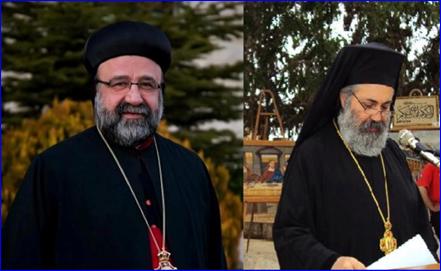
Bishop Yuhanna Ibrahim (left) and Bishop Paul Yazici.(AINA) -- On April 22, 2013 Bishops Yuhanna Ibrahim and Paul Yazici were kidnapped in Syria. During the kidnapping their driver was murdered. A fourth person in the car, Fuad Eliya, was released. Bishop Yuhanna Ibrahim is of the Syriac Orthodox Church and was considered the strongest candidate to succeed the current Patriarch. Bishop Paul Yazici is of the Greek Orthodox Church, he is the brother of the current patriarch.
The Bishops left the Turkish border on April 22, heading towards Aleppo. In the silver coloured Kia Sorrento was also Fuad Eliya and Bishop Ibrahim's driver, Fathallah Kabud. Bishop Paul Yazici was on his way home to Aleppo after an overseas trip. To get home safely to Syria he asked Bishop Ibrahim to pick him up at the Bab El-Hawa border crossing. 20 kilometers from the border crossing the car stopped at a checkpoint controlled by the Free Syrian Army (FSA) and passed without incident. About two kilometers from this checkpoint, at 3:45 PM, the car was stopped by eight heavily armed men.
According to Fuad Eliya, the only survivor of the kidnapping, the perpetrators were not Syrians, but seemed to be people who came from Caucasus. Their clothes were similar to Taliban attire. One of the kidnappers forced the driver out of the car and put himself behind the wheel, another armed man sat in the backseat of the car, and they drove behind the kidnappers' blue truck. The cars changed direction and drove back to Bab El-Hawa. This is where the Bishops were last seen.
The Chaos In Syria And Turkey's Role In The Conflict
Since the war broke out in Syria, Turkey has played an active role in the conflict. The Syrian opposition's headquarters are in Istanbul. The Free Syrian Army runs its operations virtually from refugee camps in Turkey that are placed along the Syrian border. Qatar, Saudi Arabia and Turkey have supported and financed the Syrian opposition, helping with logistics and weapons. But Turkey has played an ever more active role and has successively increased weapons deliveries to the opposition. Even the more radical groups, such as Al-Nusra and many more which are associated with Al-Qaeda, have received weapons from Turkey. The chaos in Syria has attracted jihadist groups from many countries in the region. The 900 kilometer border between Turkey and Syria has becpme a gateway to Syria for jihadist groups.
Russia has supported the regime in the Syrian civil war. Russia's support has evoked reactions from Muslims in the Caucasus region, which have been drawn to the Jihad in Syria. Jihadists from the Caucasus have two reasons to engage in the "holy war" in Syria, to help their Sunni co-religionists and to exact revenge on Russia, which according to the jihadists has been oppressing them in the Caucasus. But these jihadist groups have rarely participated in any real battles, instead they prefer to amuse themselves by plundering and murdering innocent civilians. Often they commit war crimes and crimes against humanity. This propaganda video is one of many examples showing how brutally these terrorists act. Those who watch the video can see that these terrorists are from the Russian Caucasus. The "holy war" -- Jihad -- has united many extremists from Chechnya, Dagestan, Azerbaijan, Turkey, the Balkans and many other Muslim countries. They have been able to move inside Turkey unhindered, along the Syrian border.
It has been generally known that Turkey has helped these extremists with weapon and logistics. But in the last few months Turkey has been caught red-handed several times. Turkish media that slipped past Turkish state censorship reported the following:
A truck loaded with armour-piercing rockets was stopped outside Adana, close to the Syrian border. It was heading to the rebels in Syria but was stopped at the police check point.
In early January, 2014 a police roadblock stopped a truck headed to Syria. The police began searching the truck but were stopped by the Turkish secret service, MIT, who escorted the truck to Syria. According to the Turkish ministry of interior, the cargo consisted of clothes, medicine and other emergency care for Turkmens in Syria. But the question is why a load of "emergency care" was being escorted by Turkish secret agents, which report directly to Prime Minister Erdogan. A couple of days later the Turkmens organizations denied that they had received any emergency care from Turkey.
As a result of Turkey's involvement and to the active support for the extremist groups, eleven Syrian civil opposition organizationsdecided to take Turkey to the court for Human Rights in Europe.
The Caucasus "Holy War" in Syria
The extremist group which consists of many different ethnicities from the Caucasus was founded in 2006 under the name "Caucasus Emirate" during the Chechen war against Russia. This Caucasian mobilization is now also in Syria. The terrorists from the Caucasus excel in their brutality. Abu Omar the Chechen, who founded the Hattab brigade very quickly made a name for himself. Several small groups that came from the Caucasus announced their allegiance to Abu Omar the Chechen. In Syria these groups were called the "Turkish Brothers." The Caucasus Emirate has at various times been allied with the Free Syrian Army and Al Qaeda. Lately the group has joined the Islamic State in Iraq and Syria (ISIS). Jihadist groups which are terrorising the population of Syria along the Turkish border are well known to Turkey. These jihadists are provided with weapons and communications equipment such as walky-talkies by the Turkish secret service MIT.
One of these jihadist groups is lead by Abu Amer el-Kuwaiti, who controls his operations in the Aleppo area from the Turkish border city of Antakya. Abu Amer el-Kuwaiti is assisted by a person from Dagestan by the name of Magomed Abdurrakhmanov, who uses the code name Abu Banat (in Turkish Ebu Benat). It is this person who is suspected of kidnapping the Bishops. We will return to this shortly.
During the summer of 2013 a video clip appeared on YouTube showing a person brutally cutting off the heads of three men. People in the video, including the killer, speak Russian. You can also hear a Turkish voice that says "sit down, sit down" so that there is a clear view of the slaughter. The person who is performing the decapitation in the video is Magomed Abdulrakhmanov, a.k.a. Abu Banat. The brutal slaughter drew the ire of many in many different parts of the world. When these horrible pictures appeared in the media there was speculation about who this man is. Information about Abu Banat's real identity appeared on several Russian websites and forums (here and here). When his identity was disclosed it was learned that he was a police officer in Dagestan who had found his way to Jihad in Syria.
In the beginning of 2013 Abu Banat's group established itself close to the village El-Meshed, which is only five kilometers away from the border crossing at Bab El-Hawa. He married a woman from the village of El-Meshed. Abu Banat wanted to show his authority through brutality. He terrorized the villagers and murdered a villager to set an example. He instituted harsh Sharia laws, such as those who smoke would lose a finger and those who drink alcohol will be punished. News of about Abu Banat's brutality spread. His group engaged in raids and terrorized the surrounding areas.
The group's activities drew attention and rumors started to circulate about a "fantasy camp" with lots of weapons, money, valuables and jihadists who played video games on PlayStations. News of the group's raids and brutality reached the Free Syrian Army, which sent a group of soldiers to investigate. The FSA claims the group never participated in the war against the Syrian regime but devoted itself exclusively to looting. A battle occured between the FSA and Abu Banat's group which resulted in the dissolution of the group.
Abu Banat Is Detained In Istanbul
On April 23, 2013 the police stopped a car outside the city of Konya. In the car they found a Syrian woman and three other persons of Chechen origin. All were missing valid ID documents. The Turkish magazine Radikal reported this event with the headline Orthodox Bishops' murderer arrested in Konya. The magazine also wrote that because these persons did not have valid ID documents they were deported to their home countries.
But that was not so. The police released all of them after they received a residential address in a suburb of Istanbul where the group lives.
With the memory of the brutal decapitation video fresh in his mind, one of the police officers recognized one of the persons in the car. He reported to the police in Istanbul about his suspicions of the group. A local magazine in Konya intercepted the police report and the news spread throughout Turkey. Several magazines wrote that the Bishops' murderer had been arrested in Konya. When the police searched the house at the given address they found weapons and grenades. The group was arrested for violation of the Arms Act and preparation for terrorist attacks. The group has been in police custody since the summer of 2013, in the Maltepe prison in Istanbul.
When the news about the group that was suspected of kidnapping of the Bishops spread, the authorities stated the group had been deported. Why was this stated when in reality the persons where in police custody in Istanbul? The answer was discovered after access to the police investigation report was gained. According to the report, Abu Banat is known to the Turkish secret service MIT, who have supplied him with equipment.
The Turkish Government's Handling of the Events
When the news about the arrest of the suspected murderer of the Bishops spread in Turkey, Bishop Yusuf Cetin of the Syriac Orthodox Church contacted the Turkish government. Secretary of State Ahmet Davutoglu had on several occasions commented on the kidnapping case. In a meeting with Syriac Orthodox Church Bishops, Davutoglu said that he had received intelligence reports that the Bishops were still alive and that Turkey is doing everything to save them. Secretary of State Davutoglu had given the impression that they have knowledge of who the kidnappers are. Prime Minister Erdogan also made similar statements when he visited Stockholm and met Assyrian representatives in the beginning of November, 2013. As late as last Christmas the former Turkish attorney general Sadullah Ergin said to the Greek Orthodox Church in Hatay the government was working on saving the Bishops. These and many other statements were been given by Turkish officials despite the fact that the Bishops' suspected murderer was in police custody in Istanbul. All indications point to the fact that Turkey had a hand in the Bishops' kidnapping and has therefore done everything to hide the truth about the suspected murderer.
On September 29th, 2013 investigative journalist Erkan Metin published a long article on www.suryaniler.com. During his investigation, Mr. Metin discovered that Abu Banat's is Magomed Abdurkhmanov from Dagestan and that he might be in custody. Mr. Metin contacted the police and confirmed that they were holding a person named Magomed Abdurakhmanov -- contrary to press and government reports that he and his group had been deported. Abu Banat's group was in police custody at the Meltepe prison in Istanbul.
Upon further investigation Mr. Metin discovered a link between Abu Banat's group and the kidnapping of the Bishops. A website (www.kavakazcenter.com) that belongs to the "Caucasus Emirate" featured on July 3, 2013 the headline Russian footsteps in Syria, and claimed that it was the group led by Abu Banat that was behind the kidnapping of the Bishops. The website also stated that Abu Banat is a Russian agent. The website said that according to its sources in Syria, the Bishops had been killed by an explosive belt strapped to their backs (this method is often used by the Taliban in Afghanistan).
But why would Abu Banat, who is a member of the Caucasus Emirate, be disavowed by being identified as a Russian agent?
According to Erkan Metin, the video of the decapitation on YouTube was the breaking point. The Caucasus Emirate wanted to distance itself from a group that had drawn negative attention to itself. This was also confirmed by the Turkish police interrogation ofAbu Banat about the decapitation. According to the transcript of the hearing, which was published officially in December 2013, Abu Banat said the following:
It was I who decapitated these three persons. It was the first time I had decapitated a human. But I don't understand why these came up on the Internet. It was something we did every Friday after we sentenced people in the Sharia court. I executed the punishment by decapitation.
When the report of the investigation of Abu Banat's group was released publicly the results of of Erkan Metin's investigation were corroborated -- that the group was responsible for the kidnapping of the Bishops. The following are key findings from the report:
The police made a superficial hearing and avoided going deeper into the events. No questions were asked about the kidnapping of the Bishops.
Abu Banat confessed that is was he who decapitated the persons the YouTube video.
Abu Banat said that he had received walkie-talkies from a person by the name Abu-Cahfer from the Turkish secret service.
Abu Banat and his companion were injured, probably in the battle with the FSA, and fled from Syria.
Secret documents which were published during the investigation showed that on April 26th 2013, four days after the kidnapping of the Bishops, the Turkish secret service MIT wrote a report to the state department in Ankara. In this report it described how the Bishops had been taken and moved between different locations before they were finally brought to the village Mashad Ruhin (also called el-Meshad) outside Aleppo. This information tied Abu Banat to the kidnapping of the Bishops. Since his group was using Turkish walkie-talkies, the Turkish secret service MIT monitored the conversations and mapped their activities and movements carefully.
Abu Banat acknowledged that he had committed both war crimes and crimes against humanity. The ministry of justice refused to file charges on the grounds that this was a Syrian matter.
Questions to Prime Minister Erdogan
Erol Dora, an Assyrian member of the Turkish Parliament, submitted a written question to Prime Minister Erdogan about Turkey's involvement in the kidnapping of the Bishops and the country's relationship to the suspected killer. Erol Dora also asked the justice minister Bekir Bozdag why the ministry refused to try a person who had admitted that he decapitated people in Syria. According to Erol Dora, who is a lawyer, the Turkish constitution says such crimes do not necessarily have to occur in Turkey for the perpetrator to be tried.
Conclusions
Turkey is supporting the Syrian opposition, allowing jihadist to pass through its territory to Syria. Evidence strongly indicates that Turkey knew about the jihadist group lead by Abu Banat, and this group had kidnapped the Bishops. The Turkish secret service, MIT, were in contact with this group and supplied the group with equipment.
The following are interviews with investigative journalist Erkan Metin: Turkish, Assyrian.
Dikran Ego is freelance Journalist living in Sweden; he regularly writes on Assyrian matters and is editor at Assyria TV.
New World Record Set for Single-Day Snowfall in Italy
8 Feet 4.8 inches fell in during an 18-hour period in Capracotta
Photos Courtesy of Meteoweb.eu
While Mother Nature is withholding snow in many parts of the globe, she dumped a record setting 8 feet, 4.8 inches in an 18 hour span in the mountain village of Capracotta, Italy on March 5th. The monumental snowfall set a new record for the most single-day snow accumulation in the world, taking the honor from the town of Silver Lake, Colorado. The previous record was set back in 1921 in which the Colorado town received 6 feet, 4 inches during an April snowstorm.
8 Feet 4.8 inches fell in during an 18-hour period in Capracotta
Capracotta is located in the Isernia province of Italy in the Apennine Mountains, and is know for heavy late season snowfall. There are over 10 resorts located in adjacent areas to Capracotta, making it a good late season snow destination.
Given this recent snowfall and the lackluster snow totals in the Western United States, film crews and powder hounds are gearing up and heading to Euro-land to get their pow fix.
TransWorld SNOWboarding’s ‘Origins’ movie crews are in Europe, as well as Absinthe Films, Teton Gravity Research, and many more. Cheers to all the crews getting pitted in the copious amounts of European fluff and capturing it for all to see— We’re frothing with jealousy just thinking about the pow they’re about to finagle.
Composite image of tropical cyclones Olwyn, Nathan, Bavi and Pam, generated at 12:00 UTC on 12 March 2015.
For further alerts or advisories on these and other tropical storms, visit the GDACS web site.
Composite image, comprising infrared data from the geostationary orbiting satellites of EUMETSAT and the JMA. Infrared data overlays a computer-generated model of the Earth, containing NASA's Blue Marble Next Generation imagery.
Image free to use, providing the following attribution statement is displayed "Copyright: 2015 EUMETSAT"
Tropical Cyclone Pam (Thursday 12 March 2015)
Image of Tropical Cyclone Pam captured by the AVHRR instrument onboard EUMETSAT's Metop-B polar-orbiting satellite on Thursday 12 March 2015 at 21:40 UTC.
WELLINGTON, New Zealand (AP) — Residents in cyclone-ravaged Vanuatu hunkered in emergency shelters for a second straight night Saturday after venturing out to find their homes damaged or blown away by the powerful storm, aid workers said.
Packing winds of 270 kilometers (168 miles) per hour, Cyclone Pam tore through the tiny South Pacific archipelago early Saturday, leaving a trail of destruction and unconfirmed reports of dozens of deaths.
Power remained out across Vanuatu later Saturday and people on many of the outer islands had no access to running water or outside communications, said Chloe Morrison, a World Vision emergency communications officer in the capital, Port Vila.
Morrison said communications have been so problematic that her aid group hasn't yet been able to account for many of its own 76 staff on the islands and authorities have been unable to assess the extent of the damage.
"I can say that for anybody who wasn't in a secure shelter last night, it would have been a very, very tough time for them," she said.
Vanuatu has a population of 267,000 spread over 65 islands. About 47,000 people live in the capital.
Morrison said authorities did a good job Friday moving thousands of people in Port Vila into 23 evacuation centers. With the winds and rain easing Saturday, many people stepped out only to find that their homes were missing a roof or had disappeared, and were forced to return to the shelters.
Teetering trees and downed power lines in Port Vila have made many areas hazardous, Morrison said, adding that she had heard reports of entire villages being destroyed in more remote areas.
"It's still really quite dangerous outside. Most people are still hunkering down," she said.
U.N. Secretary General Ban Ki-moon said the impact and scope of the disaster caused by the cyclone wasn't yet clear, but he feared the damage and destruction could be widespread.
"We hope the loss of life will be minimal," he said during the World Conference on Disaster Risk and Reduction in Japan. The U.N. said it was preparing to deploy emergency rapid response units.
The president of Vanuatu, Baldwin Lonsdale, who was attending the conference, told participants, "I do not really know what impact the cyclone has had on Vanuatu."
"I am speaking to you today with a heart that is so heavy," he said. "I stand to appeal on behalf of the government and the people to give a helping hand in this disaster."
Morrison said the first priority was to ensure people had adequate food, drinking water and shelter. Beyond that, she said, there would need to be a long and concerted rebuilding effort in the months ahead.
She said the winds peaked between about midnight Friday and 1 a.m. Saturday.
A westward change of course put populated areas directly in the path of Cyclone Pam. The U.N. Office for the Coordination of Humanitarian Affairs said there were unconfirmed reports of 44 deaths in Vanuatu's northeastern islands after Pam moved off its expected track.
New Zealand on Saturday pledged 1 million New Zealand dollars ($734,000) to help with relief efforts. Australia was preparing to send a crisis response team to Vanuatu if needed, Australian Foreign Minister Julie Bishopsaid.
"There are destructive winds, rain, flooding, landslides, sea surges and very rough seas and the storm is exceedingly destructive there," she said. "We are still assessing the situation, but we stand ready to assist."
The small island nation, located about a quarter of the way from Australia to Hawaii, has repeatedly warned it is already suffering devastating effects from climate change with the island's coastal areas being washed away, forcing resettlement to higher ground and smaller yields on traditional crops.
Scientists say it's impossible to attribute single weather events like Cyclone Pam to climate change.
The cyclone has already caused damage to other Pacific islands, including Kiribati and the Solomon Islands. Authorities in New Zealand are preparing for Cyclone Pam, which is forecast to pass north of the country on Sunday and Monday.


.jpg)